Showing posts with label D. Factual Programming. Show all posts

Thursday, 25 June 2015

Research

Primary Research

Before going ahead with my concept for my 3 Minute Wonder, I had to carry out multiple forms of research. Primary research is one method I used, which is self-generated research, For this I created a survey on surveymonkey.com and emailed it out to get feedback on people's views on the subject and and questions they may have. I asked a few questions to establish what gender and age groups I was getting feedback from.


It turned out that around 60% of the feedback was from females and 66% were ages 16-18. In fact, 100% of the  feedback came from nobody older than 21. This indicates that tattoos are more popular with the younger generation opposed to the older.

I found out that 100% of people who answered the survey would be interested in watching a documentary on tattoos, giving me the impression that my idea is viable to go ahead with and create my documentary on.


Secondary Research


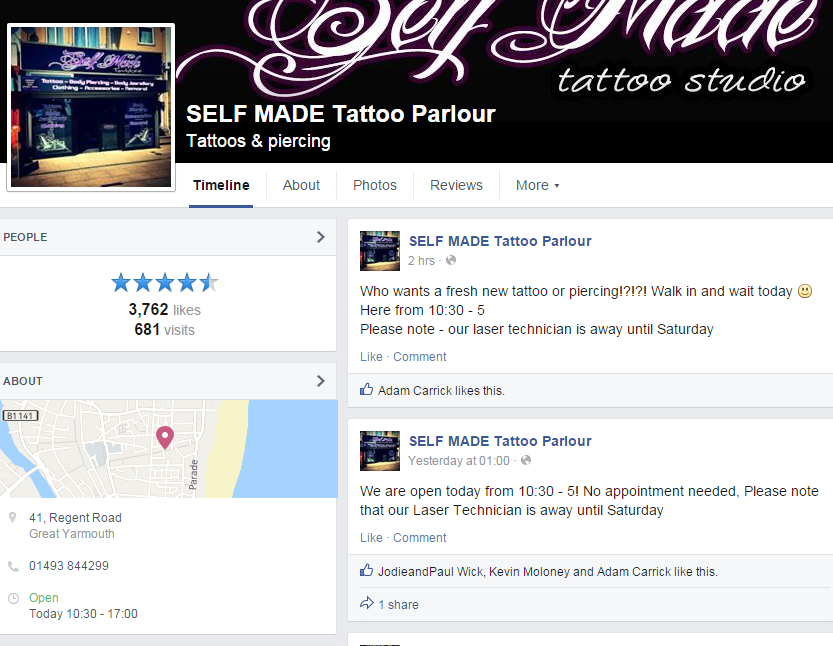
In terms of secondary research I went on the world wide web and researched the tattoo parlour that I was going to use as a filming site and get my tattoo done. This was so that I could find out about the parlour itself, and look at opening times and location for when I filled out my pre-production paperwork before filming.


Another form of secondary research I carried out was looking on the website DeviantArt, where I searched for inspiration for the tattoo that I would get done for the documentary. DeviantArt is an online photo library, full of endless images for you to browse through and get ideas from.


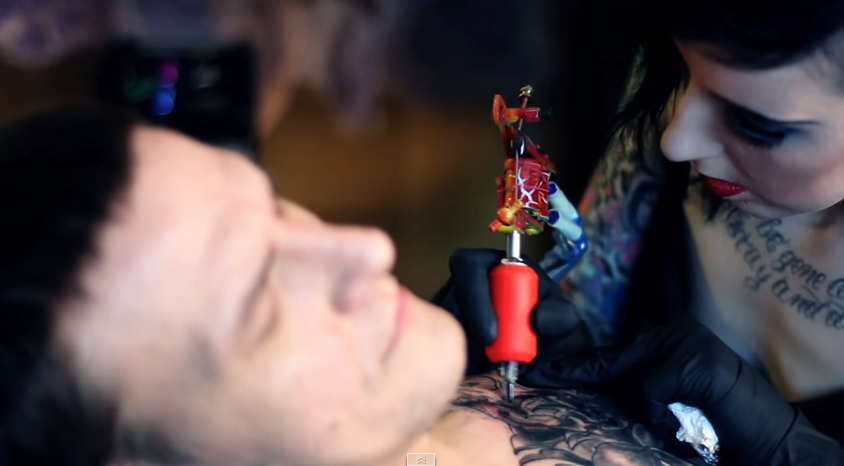
I also watched Youtube videos of any exisiting documentaries on my subject topic. This gave me ideas for the documentary genre and shots/angles to use such as the birds eye view shot of the tattoo being done. Here is an exampel of an already existing 3 Minute Wonder


Monday, 11 May 2015

The Nature and Purposes of Research in the Creative Media Industries

Primary Research/Self-generated research:

Primary research is research that is carried out by the researcher themselves. You go out and collect the data by yourself and can be done both quantitatively and qualitatively. There are many methods to go about collecting this type of research including interviews, questionnaires and surveys. Personally, for my documentary, I carried out a survey, using www.surveymonkey.com to gather data on what I should include in my documentary and what questions to ask. Another method I used to carry out primary research was interview techniques, where I set up interviews with certain individuals that would be an asset to my documentary and provide useful and unique contributions to my project. These methods were useful as they gave me a basis to go on. Without them I would not be sure if there was any interest in my concept idea, and the whole documentary could be a massive flop and not very successful at all. By carrying out primary research I'm able to find out answers to specif queries personal to myself and my own ideas.

This is from my survey showing that people would be interested in the subject field of my documentary, meaning it has an audience
This shows my using my survey to gather information on what questions to ask/answer in my documentary, meaning the audience will feel more involved in the media production


Secondary Research:

Secondary research is the process in which one gathers existing research that has already been collated. It tends to involve a summary of research previously produced for other uses in the past. Examples of secondary research include things such as books, journals, newspapers, photo-libraries and the worldwide web. In terms of secondary research for my documentary, I used photo-libraries in order to gain inspiration for my tattoo. Along with this, I used the worldwide web in order to locate the desired tattoo parlor and book the date of the tattoo. Secondary research is very useful and easy to obtain as it's already been obtained by someone else previously. It can be stored online or in text form in books, both of which are within an arm's reach into today's day and age. It allows you to see research from another point of view other than your own, making sure your research isn't bias towards what you want to find out.

This is an example of using the internet, a form of secondary research, in order to locate and book the tattoo I had for my documentary


Quantitative Research:

Quantitative research is a type of research that concentrates on numerical values and figures, with less focus on description and in-depth analysis. Examples of this include box office figures, hits on a website, sales of CD's and ratings on TV shows. In terms of my projects, I gathered quantitative research in my TV Advert questionnaire with age and gender, which provide numerical statistics to work with. This was useful as it gave me an understanding of who I was addressing and which percentage of my target audience was male and female. This is important to find out so you can veer towards one gender if required, as trying to attract males through advertising inst very useful and time efficient if there is little to no male audience. Quantitative research as a whole definitely has it's place, as it allows a researcher to gather a mass of responses to a query in little time, providing them with a broad range of results to work with and take ideas from. An example of quantitative research in the Film and TV world is using websites such as IMDB, This is an online library that stores quantitative figures such as budgets for films and the profits they bring in at the box office. Here are the figures for Jurassic World, which has actually broken the record for the opening weekend at the box office.

This is an example of quantitative research as it produces statistics on the age range of people answering the survey for my TV advert


Qualitative Research:


Qualitative research, unlike quantitative which relies on numbers and figures, focuses on peoples own views and personal opinions towards something. It is more in-depth and descriptive, and gives the researcher emotional reactions and thoughts from individuals. Examples of this type of research are reviews, like those for games, films, fan websites, responses to news coverage and discussions be it online or in person. In terms of my project, I included questions in my surveymonkey questionnaire that required a qualitative and detailed response in order to give me personal opinions and views from my target audience which I could take in and implement into my documentary. Qualitative research is very useful as it allows you to obtain detailed and personal opinions, which are going to be more helpful than vague responses, as each view will be unique. 
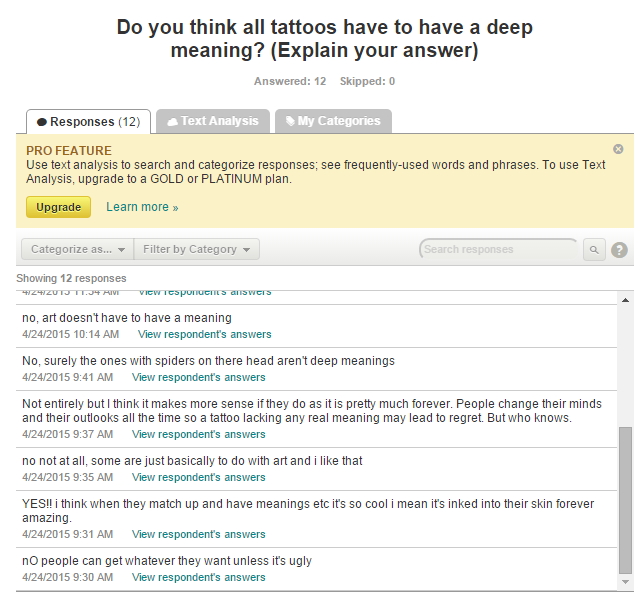
This is an example of qualitative research as it's asking the question 'Do YOU think all tattoos need a deep meaning?' which requires a personal and unique response from each individual answering, which provides varying answers


Data Gathering Agencies:

Data gathering agencies are responsible for gathering and maintaining data, The main role of the agency is to store masses of data in terms of statistics and figures which are easily relocatable for others who wish to use certain data for their own specific research/projects. One of the biggest and most well-known data gathering agencies is the Broadcasters' Research Audience Board (BARB). This is an industry standard audience measurement service that provides statistics and ratings for everything broadcast across the biggest television channels, including BBC, ITV and Channel 4. They provide statistics for both television shows and adverts. What BARB and other data gathering agencies are also useful for individual directors or production companies for example. They will reach out and get an agency to locate and retrieve specific statistics that could be genre specific. This is so if the director is going to make a superhero production, they can find out what superhero fans like to watch and why they like what they do watch through facts and figures provided by data gathering agencies. Another agency worth mentioning is IMDB. What they do is provide the largest searchable database for movie, TV and entertainment programs, and all of their cast and crew members. This would be useful for a director as they could research a specific actor they want to hire, look at what they have starred in and if the audience thought they played their role effectively in order to determine if they will carry on pursuing the actor to star in their own production. A further example is KantarMedia. They are a well-established media research agency that provide businesses with the figures they require to see what reputation and impact their efforts in media have has achieved.

Audience and Market Research:

Audience and market research is the process of gathering information on consumers thoughts and opinions, finding out their needs and preferences in order to attract them to something. Examples of this are audience profiling, demographics, consumer attitudes, competitor analysis and advertising placement/effects. In terms of my documentary, I used the surveymonkey survey I sent out to gather audience research, gathering consumer attitudes towards the topic/genre of my production and determining if it had a large enough market to justify going ahead with the idea. I found out the attitudes of my potential consumers towards tattoos, as this would give me a good idea of whether or not a documentary on that subject field would reach out and attract the desired audience. 


                               This is an example of gathering consumer attitudes, specifically on tattoos, to which
                                                                            the majority like them within reason.


Production Research:

For my production research I did many things to cover the whole of the project. To start with I worked out what technological equipment I would require, including a video camera and tripod, and made sure they were available to me on the dates and times I had set for filming. I also had to look at personnel and make sure that anyone helping me film would be available when required. In addition to this, I had to look at locations and whether they'd be available to film at on the dates I require. How I went about this was filling out location release forms and location recce forms. Finally one important part of the production research was the costs, specifically of the tattoo I had done for the documentary. I went and got a quote from the artist himself and then figured out how I would fund it. 


Friday, 20 March 2015

3 Minute Wonder Proposal (Most Viable Idea)

Tattoos

Out of all of my ideas, I feel like a short documentary about Tattoos is my most viable option for a number of reasons. Firstly, they are a great interest of mine and I have personal experience of the process involved of having one, physically and mentally. Second of all I feel like I can get interviews with professionals in this field more than the other topics, making the documentary more factual and interesting. 

Concept Overview

The basis of my documentary is to go straight into an interview talking to someone with tattoos and their views on it. Then the camera fades to myself talking about my own views and explaining that I'm now off to get a new one. Next comes footage with music of the tattoo being done. Following this I come back on camera, reveal the finished product and talk about the experience. Two more interviews follow this before the end credits roll.

For this documentary I would tackle it with an Interactive sort of approach. This is because at points I would be on-screen talking to the camera about my own views on tattoos. In terms of target audience I would have people of both genders, aged 16-20 as my primary audience. This is so I covered both people who have tattoos and those who currently aren't old enough who are considering it. The age range is there as it covers the youth and young years of a persons life, where it is more common for you to get tattoos than in later life. For my secondary audience I am targeting people aged 20-30 as they are still fairly young and are likely to still be experimenting and growing as a person at that age. When it comes to demographics, I am targeting the working class. This is because those who are very wealthy and live very high class lives stereo typically do not have tattoos.

What I hope to achieve by making a documentary on my chosen subject about tattoos is to express my views and reasons for having tattoos in a way I usually wouldn't explore. Sometimes when talking about tattoos people can have very stereotypical and judgmental views, so going in-depth talking freely about my own views appeals to me. I will film in my house, possibly the college and in the Self-Made Tattoo Parlour. A lot of the documentary is just interviews so many locations aren't required. I will do the majority of filming on my own, but will need another crew member to film whilst I am having my tattoo done. The equipment I need is a video camera, and SD card and a tripod. This is the standard set of filming kit used for productions and it gives satisfactory results. The budget for the production is around £50, the majority of this coming from the price of the tattoo itself. Below are the questions I am using to ask interviewees for my documentary.

·      What is your opinion on tattoos in general?
·      What are the reasons behind you getting tattooed?
·      How would you describe the sensation of being tattooed?

·      What advice would you give to someone planning on getting a tattoo?

3 Minute wonder Ideas Mind-Map

Monday, 16 March 2015

3 Minute Wonder Research

3 Minute Wonder


What is a 3 minute wonder?
A three minute wonder is a short Channel 4 television shot that broadcasts first time directors' three-minute TV programmes in the middle of the prime time schedule. The aim of this is so that new directors can get their work out to the public and seen by the world. Being on a prime time slot on a channel as big as Channel 4 means that a huge audience will see the 3 minute wonder allowing the director to gain recognition and maybe even star a fan base. It's a basis for stepping into the huge industry that is film making. Topics tend to be based around current issues at the time of broadcasting, that are not in the public eye and create a sense of shock of deep emotion. This includes things such as domestic abuse and depression.

Three favourite 3 minute wonders

  • Karl Pilktington - Nature
  • Street Art -
  • Beneath My Skin - Tattoo -

These are my favourite 3 minute wonders from the numerous episodes I have watched. This is for various reasons. Firstly, with the Karl Pilkington one, I think he is a entertaining person as I'm a fan of his style of humour, making the video enticing and worth watching. From watching this I learnt about Karl's views on nature and a fear of spiders he has. Next I chose the one about street art. I'm into art and am a Photographer myself. Street art appeals to me as I really appreciate the work behind spray paint work. Watching this allowed me to find out some of the existing street artists that usually keep a low profile. Finally I chose the 3 minute wonder about tattoos. Tattoos are a keen interest of my own, making the video immediately stand out to me. I have my own and could watch/talk about them for hours on end.
Tattooing something on someone for life, how does the artist feel about that?
Finding out about an actual artists life is interesting as I can find out how they feel about putting something onto someones body for the rest of their life and whether or not they feel under pressure to do so. By watching this short documentary I was able to find out how to get into the tattoo industry and become a successful artist from next to nothing.

Another reason I was able to focus on tattoos is because in recent years, it has become more acceptable and respectable to have tattoos. An example of someone who has pushed this is Kat Von D, an American tattoo artist who has helped promote tattoos through the TV show LA ink. 


It's also becoming more of a trend to get tattoos for deep meaningful reasons, symbolizing experiences and struggles you have been through. An example of this is the "semicolon tattoo" which are spreading across the globe. The meaning of this is solidarity for those struggling with mental health issues. It's a way of expressing this, where people may have previously struggled to through speech, and also allows them to relate with others. 


TV Listings:
The TV listings for Channel 4 on the 22nd June show that a fair percentage of the broadcasts are of a documentary format. There are 6 on this date, including Phil Spencer: Secret Agent, Jimmy's Australian food adventure, My Tattoo Addiction and Obsessive, Compulsive Cleaners. This shows that Channel 4 are fond of Documentaries and they are obviously popular with viewers due to the increased numbers of them on screens today. The peak time in the UK is 5:30pm-11pm and in this time there are two documentaries on Channel 4. On the same day, ITV4 has 5 documentaries broadcast, being repeated throughout the day making a total of 10. These include Ax Men, Pawn Stars and Storage Wars. There are 7 on during peak time in the UK, the majority coming from back to back episodes of Storage Wars. 


BARB:
The Barb figures for factual programmes in general are fairly popular, but don't tend to exceed the figures of the soaps, which are the most watched shows consistently. For the week ending the 14th June the documentary Countryfile hit 5.86 million viewers landing it 6th in the rankings, only behind Eastenders and an episode of The Syndicate. Another popular documentary that hit the top 30 list for the week is Watchdog, a programme about crime and finding criminals still on the loose. It hit 3.36 million viewers in it's latest installment.


Monday, 9 March 2015

Introduction to the News

Part 1 (News Broadcast)

The broadcast I have chosen to look at is Look East from 8th March 6pm 2015. There is an opening titles with music and images from around the East of the country, with intent to connect with the more niche, personal audience. The reason they are there is so that the viewers get used to them and relate the opening sounds to the news, which will grab their attention ready for the programme. The visuals of local areas allow the audience to feel involved and able to relate to what is on the screen. The titles end with the title 'Look East' with other routes to reach them listed below, like Facebook and Twitter for example. In this broadcast the first story is about 240 jobs across the east on the verge of being lost as councils cut costs by 313 million. 181 of them are in the regions unitary authorities as they try to freeze council tax this year. Next was a story about Northampton shire County Hall redeploying 4000 staff leaving them with just 150 employees. The third story was about a teenage girl who had been sexually assaulted near Suffolk Police Headquarters. The final main story is on Michael Foale, the former NASA astronaut who has been at Cranfield University for school holding an event called Mission Discovery. Drawing the show to a close comes the sports news, where Norwich's hope for automatic promotion takes a boost, whilst Ipswich lay a place off of the play-offs. The show then ends with the weather. 


Part 2 - Role of Presenters


In the broadcast I watched yesterday, the presenter was Jenny Kirk. She is a middle-aged female around the age of 40-45 who presents the Look East 30 minute broadcast from 6 O'clock. In the news, the role of presenters is one of great importance. The presenter is the one in the news team who has the job of delivering the news to the viewers at home by directly speaking to them. The difficulty of the job varies depending on the show they are presenting, and it's of course different everyday. Appearance wise presents tend to be middle aged and a little older, and are required to dress to a formal, professional standard. This is so those at home watching see the appeal of the presenters and like them, as a lack of interest in the presenter could potentially effect viewing numbers, since the presenter has a lot of screen-time and interaction with the consumer. There is only one presenter in this news broadcast as it's a fairly short show, but usually there will be two, both a male and female, so viewers of both genders are happy and have a presenter to relate to if needed. Also, when there is a lot of news, whilst one presenter is speaking, the other will be listening to their ear piece ready for the next story that they will be covering. How they tell the story is with an earpiece, where they are spoken to throughout the broadcast by the director, producers and others all at the same time. A key skill of presenters is to not show any stress they may be feeling as it will have a negative impact on the audience. They have to appear like they are in complete command throughout, even when in their earpiece things aren't playing out quite as intended.


Part 3 - Huw Edwards

The term ordering news is to assemble a series of text based reports together in a priority first to last process, ready to broadcast to an audience. This is to keep the audience interested, watching and listening until the end. The story that is shown first is called the leading story. This is shown first because it's the most current, big story, sometimes breaking news, and will affect/involve a large percentage of the audience. After this the remaining stories are ranked in terms of interest for the audience. The ability to think and act quickly is important as in the news things can change any second, so you have to flexible and be able to alter the running order at any moment. The term ;slow news day' means that there is no breaking news, or any big, important leading stories to broadcast, so not a lot happening, meaning the broadcast is filled up with minor, low priority stories. An example of this is when you get stories about local shops or farms, showing you what they do and run their business, which you wouldn't see if there had been big events such as deaths that day. The final story is often called the 'round-up' and this is so you can group multiple stories that have similar topics together so you are delivering more to the audience but in the same time frame. An example of a 'round-up' is sports, specifically football, going through multiple leagues and multiple results in a small amount of time. 'News Values' are general guidelines/criteria that are used by media outlets. It's a set of factors that different media texts have in common. In 1965, Galtung and Ruge analysed international news stories and came up with a set of news values. These values include negativity, recency, continuity, personality and size.


The Chowles

This story was a bout a family of 3 (soon to be four) known as The Chowles. They have been struggling to pay of the mortgage on their house due to Mrs Chowles being a stay at home mum, and Mr Chowles has been too ill to work. The family now face being kicked out of their home and bailiffs coming to take their possessions as payment. Involved in the story is Pierre, the husband and father, Christina, his wife and their baby. Also the dog makes an appearance.  In the broadcast, the family are represented in a vulnerable light and are victimized. This causes the average viewer to have pity on them and their situation. Personally I pity the Chowles family to an extent. They have had a hard time and looking after a kid in such poor financial circumstances cannot be easy. I also know it's tough paying for bills and a house in today's economy for the majority of the population so it is relatable. On the other hand, I don't think they should be having a second child when they know they cannot afford it. The news story does have a narrative to it. It was based on a happy family, shown by the children playing with their toys in the opening shot, which has been met with destruction due to financial issues. The narrator is also an important part of the story. Without the voice over, the viewer doesn't know what is going on, as the family don't explain the whole situation themselves, and instead just give their opinion and answer questions from the interviewer.


Part 5

I have chosen to analyse and talk about a BBC News broadcast called 'Power chairs'. This story is about a man who's daughter was diagnosed with a spinal disability meaning she would need an electric wheelchair from 18 months old and for the rest of her life. He took this on board and made her one himself, and now 30 years later children are still benefiting from his inventions. People present in this story are Ruth Everard, the daughter of the inventor and now director at their business 'DragonMobility'. Also included are David a child suffering the same illness and his dad Jonathan, and Charlie a further young boy suffering the same illness and his mother Aimee. Ruth is seen as a victim that has become an inspiration for everyone suffering from the spinal disability that she does. The two young boys are represented as victims which they are, but they are making the most out of their lives being very positive, and their parents are not wallowing in pity and crying for help. I feel like everyone in the story is brilliant and people to admire. They have all had to deal with the disability in some way, whether it be personally or being the parent of a sufferer, and they haven't thrown in the towel at all. They are surrounded with positive vibes making the most of what they have. The story had a narrative as it begun with Ruth's story as a child and the discovery of her illness and invention of her electric wheelchair. After this the audience is taken back to the present where other sufferers are gaining the same benefits that Ruth has, showing that the invention was helpful for a lot of people.


Part 6

1) Selection and Omission - Editors can express bias by choosing whether or not they want to include a specific news story or leave it out. Also, specific elements of the story can be ignored and left out, causing the audience to have a different opinion on the story. This type of bias can only be noticed by the comparison of multiple sources. An example of this is a news story about the Queen receiving gifts in Berlin. The Mirror have only included questionable and negative comments by the Queen on them, making her appear ungrateful. Link to story - http://www.mirror.co.uk/news/uk-news/is-supposed-father-queen-disses-5940414

2) Placement - Depending on where a story is placed people will have a different view on it's importance. Stories on a front cover or at the start of a radio show are thought to have greater value than ones towards the end of the magazine/show. Here is an example of placement Bias. A story about an individual doing drugs is at the top of the news page and has a larger image and text than stories below, making it out to be more important than them, which it isn't as there are deaths and stabbings below.


3) Headline - headlines are what stand out, with a big, bright and bold font. They can be misleading expressing excitement for a mundane story, or put forward opinions of the minority. Here is an example of a misleading headline, as it's branded 'worst divorce ever' when really it's just a man cutting objects in half. It could have been far, far more extreme and certainly isn't the worst ever. Link to story - http://www.mirror.co.uk/news/weird-news/jilted-lovers-worst-divorce-ever-5937987?ICID=FB_mirror_main

4) Captions, Photos and Camera Angles - Pictures can easily effect someones appearance, making them look more attractive, evil, older etc. than they really are. This can easily alter someones perception of a person or event. Here is an example of a photo and caption being misleading, as the cat is branded brave as it approaches a lion, but the photo is cropped to hide the fact that it's through a thick glass window of a door.

5) Names and Titles - News Media constantly label people and places where interviews are taking place on the news. These can be biased and reflect the view of just the editor, or a minority and not that of the general population. Here is an example of a title that may be just the view of the editor, or a minority. Here the footballer Steven Gerrard is branded an 'Anfield Legend' but this isn't necessarily the view of everyone reading. The editor could be a Liverpool fan himself. Link to story - http://www.mirror.co.uk/sport/football/news/steven-gerrard-admits-liverpool-title-5936674?ICID=FB_mirror_main

6) Choice of Words - The use of positive and negative words can influence someones view, and also the tone of voice a newscaster uses will effect the way people see the subject topic. An example of this is a news story about drug problems in Britain. The use of the negative word 'tragic' is used which would immediately push readers to have a feeling of sympathy towards sufferers, when in reality they may have no compassion towards drug addicts at all. Here is a link to the story to see for yourself - http://www.mirror.co.uk/news/uk-news/tragic-images-drugs-den-reveal-5942937?ICID=FB_mirror_main