Primary research is research that is carried out by the researcher themselves. You go out and collect the data by yourself and can be done both quantitatively and qualitatively. There are many methods to go about collecting this type of research including interviews, questionnaires and surveys. Personally, for my documentary, I carried out a survey, using www.surveymonkey.com to gather data on what I should include in my documentary and what questions to ask. Another method I used to carry out primary research was interview techniques, where I set up interviews with certain individuals that would be an asset to my documentary and provide useful and unique contributions to my project. These methods were useful as they gave me a basis to go on. Without them I would not be sure if there was any interest in my concept idea, and the whole documentary could be a massive flop and not very successful at all. By carrying out primary research I'm able to find out answers to specif queries personal to myself and my own ideas.
 |
| This is from my survey showing that people would be interested in the subject field of my documentary, meaning it has an audience |
 |
| This shows my using my survey to gather information on what questions to ask/answer in my documentary, meaning the audience will feel more involved in the media production
Secondary Research:
Secondary research is the process in which one gathers existing research that has already been collated. It tends to involve a summary of research previously produced for other uses in the past. Examples of secondary research include things such as books, journals, newspapers, photo-libraries and the worldwide web. In terms of secondary research for my documentary, I used photo-libraries in order to gain inspiration for my tattoo. Along with this, I used the worldwide web in order to locate the desired tattoo parlor and book the date of the tattoo. Secondary research is very useful and easy to obtain as it's already been obtained by someone else previously. It can be stored online or in text form in books, both of which are within an arm's reach into today's day and age. It allows you to see research from another point of view other than your own, making sure your research isn't bias towards what you want to find out.
|
 |
| This is an example of using the internet, a form of secondary research, in order to locate and book the tattoo I had for my documentary
Quantitative Research:
Quantitative research is a type of research that concentrates on numerical values and figures, with less focus on description and in-depth analysis. Examples of this include box office figures, hits on a website, sales of CD's and ratings on TV shows. In terms of my projects, I gathered quantitative research in my TV Advert questionnaire with age and gender, which provide numerical statistics to work with. This was useful as it gave me an understanding of who I was addressing and which percentage of my target audience was male and female. This is important to find out so you can veer towards one gender if required, as trying to attract males through advertising inst very useful and time efficient if there is little to no male audience. Quantitative research as a whole definitely has it's place, as it allows a researcher to gather a mass of responses to a query in little time, providing them with a broad range of results to work with and take ideas from. An example of quantitative research in the Film and TV world is using websites such as IMDB, This is an online library that stores quantitative figures such as budgets for films and the profits they bring in at the box office. Here are the figures for Jurassic World, which has actually broken the record for the opening weekend at the box office.
 |
 |
| This is an example of quantitative research as it produces statistics on the age range of people answering the survey for my TV advert
Qualitative Research:
Qualitative research, unlike quantitative which relies on numbers and figures, focuses on peoples own views and personal opinions towards something. It is more in-depth and descriptive, and gives the researcher emotional reactions and thoughts from individuals. Examples of this type of research are reviews, like those for games, films, fan websites, responses to news coverage and discussions be it online or in person. In terms of my project, I included questions in my surveymonkey questionnaire that required a qualitative and detailed response in order to give me personal opinions and views from my target audience which I could take in and implement into my documentary. Qualitative research is very useful as it allows you to obtain detailed and personal opinions, which are going to be more helpful than vague responses, as each view will be unique.
|
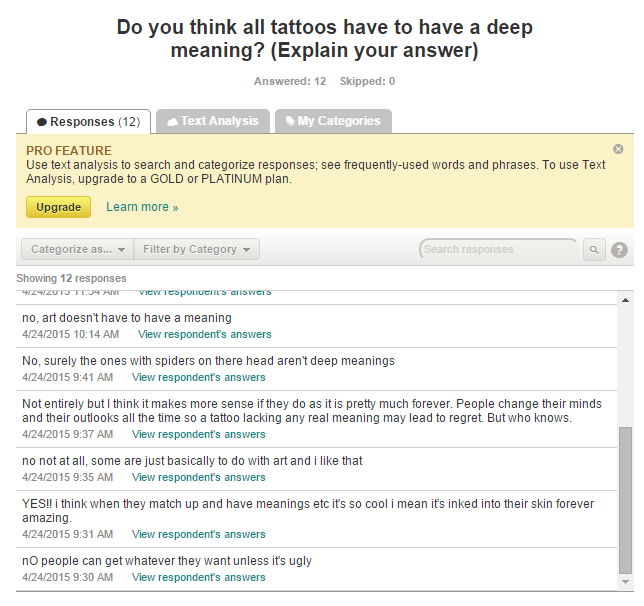 |
| This is an example of qualitative research as it's asking the question 'Do YOU think all tattoos need a deep meaning?' which requires a personal and unique response from each individual answering, which provides varying answers
Data Gathering Agencies:
Data gathering agencies are responsible for gathering and maintaining data, The main role of the agency is to store masses of data in terms of statistics and figures which are easily relocatable for others who wish to use certain data for their own specific research/projects. One of the biggest and most well-known data gathering agencies is the Broadcasters' Research Audience Board (BARB). This is an industry standard audience measurement service that provides statistics and ratings for everything broadcast across the biggest television channels, including BBC, ITV and Channel 4. They provide statistics for both television shows and adverts. What BARB and other data gathering agencies are also useful for individual directors or production companies for example. They will reach out and get an agency to locate and retrieve specific statistics that could be genre specific. This is so if the director is going to make a superhero production, they can find out what superhero fans like to watch and why they like what they do watch through facts and figures provided by data gathering agencies. Another agency worth mentioning is IMDB. What they do is provide the largest searchable database for movie, TV and entertainment programs, and all of their cast and crew members. This would be useful for a director as they could research a specific actor they want to hire, look at what they have starred in and if the audience thought they played their role effectively in order to determine if they will carry on pursuing the actor to star in their own production. A further example is KantarMedia. They are a well-established media research agency that provide businesses with the figures they require to see what reputation and impact their efforts in media have has achieved. Audience and Market Research: Audience and market research is the process of gathering information on consumers thoughts and opinions, finding out their needs and preferences in order to attract them to something. Examples of this are audience profiling, demographics, consumer attitudes, competitor analysis and advertising placement/effects. In terms of my documentary, I used the surveymonkey survey I sent out to gather audience research, gathering consumer attitudes towards the topic/genre of my production and determining if it had a large enough market to justify going ahead with the idea. I found out the attitudes of my potential consumers towards tattoos, as this would give me a good idea of whether or not a documentary on that subject field would reach out and attract the desired audience.  This is an example of gathering consumer attitudes, specifically on tattoos, to which the majority like them within reason. Production Research: For my production research I did many things to cover the whole of the project. To start with I worked out what technological equipment I would require, including a video camera and tripod, and made sure they were available to me on the dates and times I had set for filming. I also had to look at personnel and make sure that anyone helping me film would be available when required. In addition to this, I had to look at locations and whether they'd be available to film at on the dates I require. How I went about this was filling out location release forms and location recce forms. Finally one important part of the production research was the costs, specifically of the tattoo I had done for the documentary. I went and got a quote from the artist himself and then figured out how I would fund it. |